

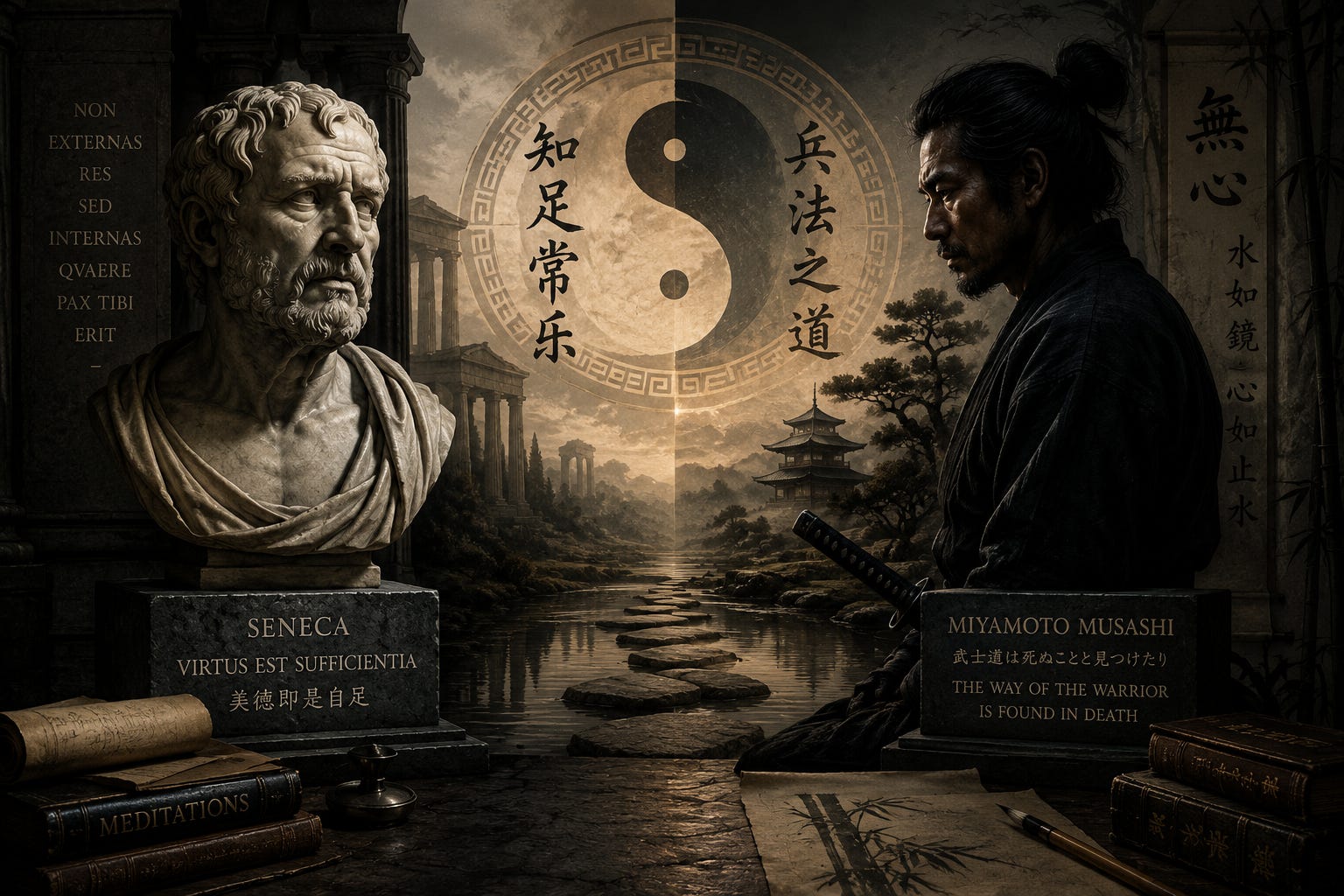
Precepts. A word rooted in ancient times, but a timeless concept nonetheless.
Precept: a rule or principle that guides conduct or action.
More than advice, it carries the weight of obligation.
A precept is something you live by, not just agree with.
Etymology:
From Latin praeceptum — “a maxim, rule, order,” derived from praecipere, meaning “to instruct beforehand” or “to take in advance.”
Broken down: prae (before) + capere (to take, to seize).
The root capere is deeply alive in English; capture, concept, perceive, and receive all share it. To precept someone is, at its root, to seize their understanding before they need it, or to hand them a rule that will hold when the moment of decision arrives.
A precept isn’t reactive; it’s preemptive.
My thesis: In my derivative (i.e. blender) philosophical approach that draws into it components of Roman Stoic dogmata, my father’s street savvy, common sense wisdom, the writings of Japanese sword master Musashi as well as my military and civilian career lessons, I have taken all of this collective wisdom to decide in advance how I’ll meet the world and its challenges so I don’t have to reason it out under pressure.
It’s said that a man who has precepts doesn’t deliberate in the moment; he already knows.
A code to live by made up of precepts, Ancient, Modern, Eastern, and Western, taken from their schools of thought and stitched together.
As I approach 60, I wish I had full command of my code when I was younger, but life doesn’t work like that. You live, you learn, you make mistakes, and if you are learning from all of these experiences, you develop wisdom. I’ve benefited from having very good role models in my life, older gentlemen who, wittingly or unwittingly, shared their life lessons with me. I’m willing to share 40 years of my adult life lessons with anyone, especially young men, who would like to accelerate and put into action parts of their personal code they may not have considered yet. I try to be humble, but I’ve done something right in my life: Of living Americans, only 0.2% can say they have reached the CEO level, and only 0.05% can say they served on an American Submarine. Not bragging, just the bona fides.
When my son was growing up, he loved to watch NCIS. On the television show, the lead Agent, Special Agent Leroy Jethro Gibbs, had a set of rules, precepts, and a code that his agents had to know.
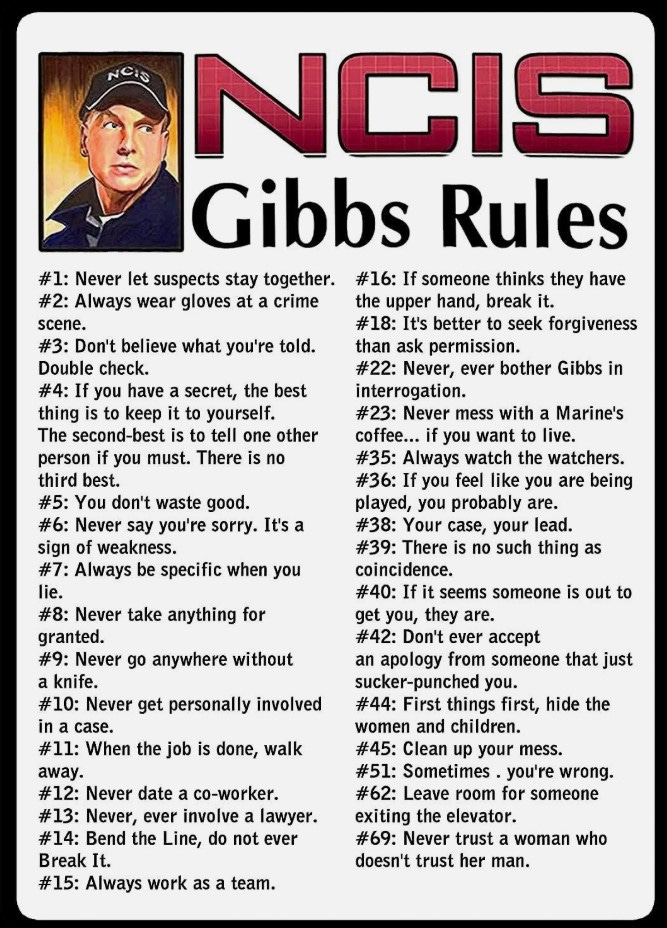
This was the first time, in the early 2000’s, around or just before my 40th birthday, that I considered the concept of an actual code that wasn’t just figurative but real and actionable.
Ryan Holiday, who arguably has done more than anyone over the past two decades to revive the words of ancient philosophers, brought the concept of stoic philosophy to Boardrooms, Locker rooms, and to average, unassuming people looking back to make sense of their lives. Ryan has sold over 10 million copies of his books across more than 40 languages worldwide.
Holiday’s books are built around principles, maxims, and meditation, but they are primarily presented as insights to absorb and ponder, not as precepts to live by. The structure is: here’s a Stoic idea, here’s a historical example, here’s what it means for you. It’s illuminating, but it’s fundamentally descriptive.
A precept is different. It’s prescriptive and personal, a rule you’ve adopted as binding on yourself. “Do not act on what you cannot control.” “Never mistake motion for progress.” “Hold the line when no one is watching.” Those aren’t observations. They’re commitments.
Precepts come close to formal laws, ethical categorical imperatives. The Ten Commandments from Judeo-Christian writings or the Surah Al-An’am, and the slightly longer and more encompassing Surah Al-Isra, from the Koran, with both Abrahamic religions citing the words of God given to Moses in stone.
Holiday gives you the raw material. He hands you Marcus Aurelius, Epictetus, and Seneca, distilled and made readable. But he stops short of saying how to apply them; he leaves the actionable part up to the reader.
Musashi understood this distinction instinctively. The Dokkōdō (The Way of Walking Alone) isn’t a meditation but rather 21 blunt, actionable precepts, each an insightful imperative, presented without explanation or anecdotes.
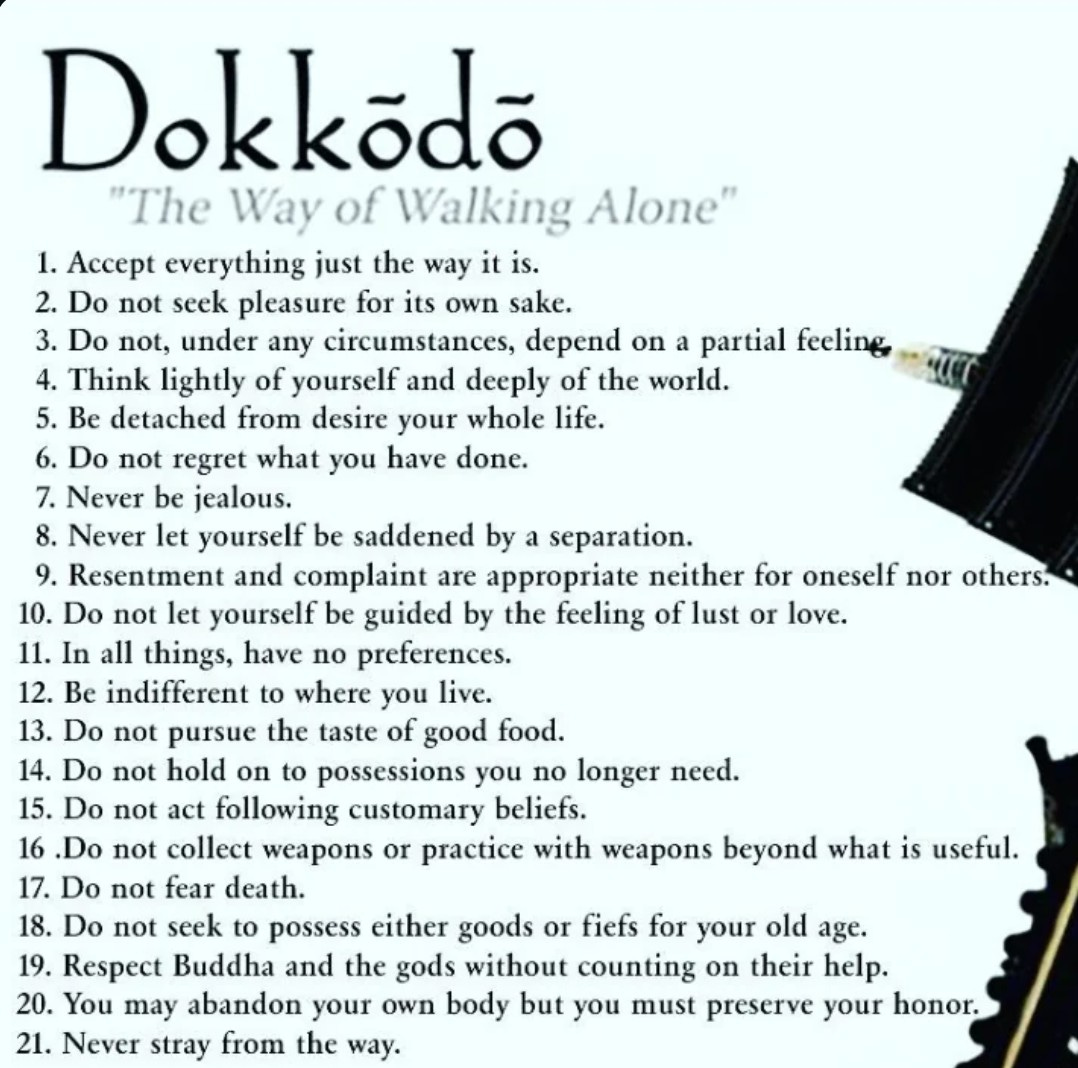
With those inspirations, I present what I’ve entitled “20 Precepts for Walking in Harmony.” I strive to walk in harmony with the world, not stand out, not aggrandize myself, not take more than I give, but to be in harmony. Like Musashi, with as few anecdotes as possible.
Be your own best friend. No one is coming to do that work for you, and no one should have to.
Loyalty matters. If someone is in your small circle, friend, family, or teammate, they deserve your loyalty and the benefit of the doubt when an explanation is required.
Keep your word. If no one can treat your word as absolute, you have nothing.
Don’t be a hypocrite. Better to suffer reputational damage than to lie to yourself or others about your shortcomings. Work at them!
Never initiate violence. De-escalate when possible. React violently and overwhelmingly if left with no choice.
Show respect to everyone, regardless of anything. When unsure, address as Sir or Ma’am, move to one side of the sidewalk as people pass by, hold doors open, say please and thank you, and make no scenes or commotions.
Dress in clean, well-maintained clothes and maintain high standards for hygiene and grooming.
Never interrupt while another is talking. Conversely, listen well, not just politely.
Apologize fully, or not at all. Don’t explain away or justify; context is required unless asked for.
Carry your cross in silence. Everyone has problems; no one needs to hear about yours.
Protect your own dignity, and that of others around you.
Demand more from yourself than you would ever demand from another man.
Cut ties immediately with anyone who mistreats animals or dislikes pets (absent cultural/religious context).
Don’t evangelize your religious or political doctrine. Don’t suppress who you are, but equally, don’t assume others care, endorse, agree, or want to hear your views.
Your children come first. Not the softball team, not the pickup hockey league, not the motorcycle club runs, not drinks with the fellas. Don’t have children if you aren’t prepared to be the father they deserve.
Simple wisdom is still wise. Listen to advice from whoever offers it. "When you're in a hole, stop digging.” Rank or status doesn’t add merit to the advice.
Stay Authentic. Comport yourself honestly, always, in every situation. You’re not an influencer, you’re not peddling illusions.
Only mix business and personal relationships with extreme caution. It becomes harder to make dispassionate decisions in business when your family members develop friendships.
Mind your Resources. 1/3 of your income is saved. 1/3 of your income is for living expenses. 1/3 of your income is for pleasure. Change the ratios, not the intention.
Journal bravely. Humble your ego and speak the truth to yourself, as painful as it might be. Never lie to your journal.
Are these the only precepts I live by? No. Categorical imperatives, such as thou shalt not kill, I’ve left off as obvious and not required. Will they change over time? If I wanted to expand the list to 21, I would have added to “…Plot endlessly. Review your plans, edit, modify, execute, and assess. If something’s not working, change.” I don’t believe in doing the same things over and over again because that’s “…just how I’ve always done it.” I actively try to always be evolving because I equate the end of evolution as the end of active living, and the moment we wait for our time to end. I’m too young and too dialed in for that.
I am not widely read. If this resonates with you, share it. If you abhor it, say so. My sincere desire is to reach one young person and make a positive influence on their thinking.
If you're curious about the Latin quote in my graphic with Seneca and Musashi, it reads: “Seek not external things, but internal ones, and you will find peace.” The precepts sometimes write themselves.
I look forward to your writings. Absolutely inspirational!
As Always, Thanks Brother!